54B, Tailstoi Town 5238 MT,
La city, IA 522364

We Are Modern Industry
In Los Angle
Our experienced team offers services for both residential and commercial properties.With over 25 years of experience in the industry, we boast all of the knowledge and expertise in repairing.

Engineering Excellence
Globally Delivered
Predict. Optimise. Perform. Non-linear polymer analysis for rubber and polyurethane.
We engineer solutions that have been virtually proven before they are physically built. Our integrated R&D division uses advanced Finite Element Analysis to bridge the gap between theoretical design and real-world performance reducing prototyping costs, shortening development cycles, and ensuring every component is optimised for its operating environment.
Most FEA is built around linear elastic materials. Rubber and polyurethane are hyperelastic, viscoelastic and non-linear in ways standard FEA cannot model. UMP’s specialised capability is built specifically for these materials and it changes what’s possible.
Why standard FEA isn’t enough for polymers
Linear FEA assumes twice the force gives twice the deflection, and the material returns exactly to shape. For steel within its elastic range, fair. For rubber and polyurethane, fundamentally incorrect.
Where UMP FEA adds most
Efficiently unleash cross-media information without cross-media value. Quickly maximize timely deliverables for real-time schemas. Dramatically maintain clicks-and mortar functional solutions. Efficiently unleash cross media information without cross-media value.
-
Stress and Strain, predict deformation and maximum strain.
-
Contact, model interaction with mating surfaces.
-
Large deformation, where geometry change itself affect load distribution.
-
Thermal, temperature distribution where internal heat generation matters.
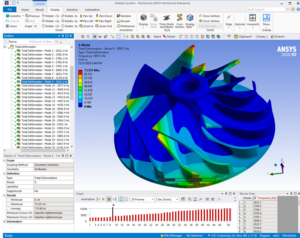

FEA-supported development process
-
Concept design
Rapid parametric study of geometry options, identify the optimal configuration
-
Detailed design
Full non-linear stress/strain/contact analysis, validate against criteria
-
Design optimisation
Targeted geometry changes to cut peak stress, improve fatigue life or reduce material